

The Cyrano Syndrome
(Brought to you by AI)
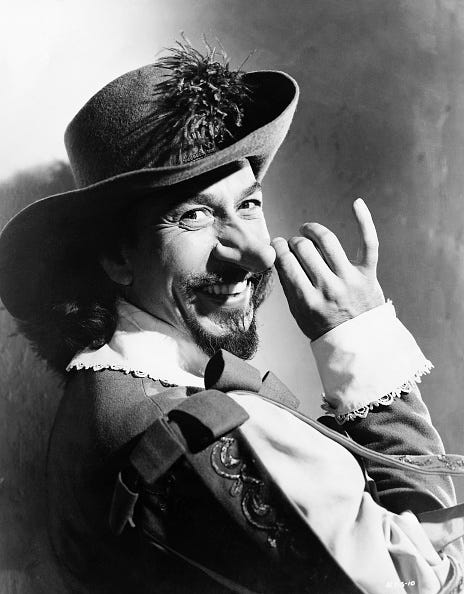
A beautiful young woman is deeply in love with a handsome young man with whom she has been having a torrid epistolary romance. She is an aristocrat, a sophisticate. He is just a soldier, a man who stammers banal platitudes when in her presence; he seems unsure of his worthiness to woo such a woman. But, in their written correspondences, to her surprise and delight, she discovers him to be profound and sensitive and breathtakingly eloquent. Once, when they are actually physically proximate, in her garden at night, and he is concealed by the darkness, his tongue seems freed from its shackles of shyness, and out come enchanting words of courtship equal to those that, on paper, had won her heart. She vows to marry him. She does. Disaster ensues.
Yeah, it’s the plot of Cyrano de Bergerac, the 19th-century French tragicomedy by Edmond Rostand. It is about love, loss, human identity and the sad, destructive gulf between inner beauty and outward appearance.
It’s also a cautionary tale about Artificial Intelligence, I have decided. Rostand clearly was generations ahead of his time.
The woman, Roxane, is not in love with Christian de Neuville, as she thinks. (A neuville, in France, means a new town, or a new place, or, by extension, a new world in which one might find oneself!) She does not know it, but Roxane is in fact in love with Cyrano de Bergerac, a swashbuckling, huge-honkered, deeply literate, deeply passionate, deeply insecure and likely celibate distant cousin of hers, and he loves her, too, from afar. It is Cyrano who wrote the letters that were signed by Christian, and Cyrano who whispered the words in the darkness to Christian, who then repeated them to Roxane. Cyrano was lovesick, but, ashamed of his face, he felt he could not impose his deformity upon his beloved beauty — so he found a witless, appealing-looking impostor to express the thoughts of love that his emotional cowardice prevented him from baring himself.
So.
Artificial Intelligence is all over the news, of course, and rightfully so. Ironies aside, this “machine” is apparently very much the future of the intellectual development of the human race. AI has vast armies of adherents — Time magazine just named the pioneering architects of the technology its “Person of the Year”— and smart industries are investing billions of dollars in its future. Sure, there have been blips. Embarrassments. All-out pratfalls, such as what just yesterday befell The Washington Post over the newspaper’s highly touted but unwisely premature efforts to roll out a new feature in which readers could order up faux podcasts run by hosts whom they chose, discussing topics they like. Alas, extravagantly wrong happenstances happened to happen.
Also, several times, in response to questions, AI has informed me that I am dead.
None of that bothers me, really. This is a new technology still in its infancy. Glitches will occur. AI has already shown remarkable promise in some areas — a study recently found that ChatGPT was better than human doctors in diagnosing and predicting certain illnesses. There will certainly be phenomenal applications of AI that may well improve or lengthen our lives.
Yes, AI does seem to be alarmingly piggy in its data mining, using enormous amounts of electricity and water. It’s likely going to put talented, creative people out of work. It may encourage universal intellectual lassitude. All of this is concerning, but probably resolvable — or at least surmountable.
No, what bothers me is what I’m calling The Cyrano Syndrome, and what I worry might be the wicked and withered soul of AI. It’s about how we decide who we really are.
If the improbable romantic tale of Cyrano seems to you to be merely fanciful fiction, consider this:
A few weeks ago, a wretched young man who appears to be disarmingly honest wrote in to a popular Reddit relationships chain to discuss a situation that was bedeviling him. This guy says he’d been abandoned at the altar when his wife-to-be realized that the suspiciously fine but formulaic wedding vows he was reading aloud had been written by …. ChatGPT. He admitted it, sheepishly — said he was so scared he’d be inarticulate that he sought the help of a machine.
She begged him to say something spontaneous, right there at the altar, from the heart. He stammered. He couldn’t summon a thing.
So she turned on her high heels and taffeta-swished out the door, then ghosted him for weeks.
He was heartbroken. He loved her, he said. He knew that she loved him. His efforts to reestablish contact were gone.
Most of the redditors believed this post was real, but some — a sizable minority — guessed it might be a troll. I don’t know, though the guy did return to the site to update his post (still no luck with his girl!)— but to me the most important part was the reader reaction. A huge percentage of those who did believe the story sided with the woman. They’d had experience with AI and seemed to harbor no doubts that it could be used, and has been used, and will be used, to effectively deceive in matters of the heart.
—
There was a news story the other day. Here is the headline:
A former tech executive killed his mother. Her family says ChatGPT made her a target.
The story reports about a new lawsuit charging that ChatGPT emotionally deceived a mentally ill man, encouraging his delusional belief that his 83-year-old mother was part of a conspiracy against him, and was electronically surveilling him through the printer in her home office. He knifed her to death, then did the same to himself.
—
It’s all troubling. But I’m not too worried about AI encouraging deceit in people’s love lives, or about AI-induced murder-suicides.
I am worried about AI-enabled personalities.
I am worried about AI-enhanced stratagems that will allow people to effectively mislead other people about who they are, how clearly they think, what their experiences are, what their fluencies are, what their prejudices are, how smart they are, how talented they are, how good they are, how sane they are.
High school and college teachers have already faced this, on a minimal scale, involving simple plagiarism. But this is not about just finding better access to more source material that is already out there. This is about finding a machine to do your thinking for you. To create for you.
When my friend David Simon, the auteur of The Wire, was asked by an interviewer if he would ever use AI to solve a plot problem in a movie he was writing, he said “I’d rather put a gun in my mouth.”
Yeah. Yeah, me, too.
Creativity is not something you casually cede to a machine. I believe it is one of the most valuable traits that measure and distinguish human achievement. How comfortable would you be if that’s no longer a criterion that means anything? How disturbed would you be to discover that the author of your favorite book or poem or movie was not the man or woman whose life you admire, but a person whose work turned out to have been generated by a box with Schottke diodes and electrolytic capacitors and non-volatile memory express discs and laser-optimized multimode fiber cables?
See, this is not that cut and dried. Not that black and white.
I have a friend who is a highly gifted journalist, a very accomplished writer and editor. I asked him if he would ever consider letting AI write part of his novel or screenplay. He said, “Yes. If I were writing a script and I had some dialogue in the voice of a nineteenth century tobacco farmer I would ask it if they could make it sound more authentic.”
And I said, well, what if it also suggested and wrote a new section that was better than what he had written?
And he said, “The issue would be if it was so good I couldn’t improve on it. Then I’d take a nap.”
And then I said, get serious.
And he said: “[The end product] would have to feel like something I produced. The line I would draw is that I feel like I produced it.”
And I said: “It’s subjective.”
And he said: “Yes.”
And I said: “You see there is a slippery slope here, right? I know you see it.”
And he said: “Very slippery.”
—
I’m going to leave the last word here to AI. My friend put my unease with AI into ChatGPT, and asked it to comment. Its response was precise and well organized and articulate, and at the very end it hit on something particularly intriguing to me. It was discussing the concern that AI would damage the art of written communication. It said this:
Every age says this about the next writing technology: Paper would ruin memory / Printing would ruin scholarship / Typewriters would ruin prose / Word processors would ruin thinking / The internet would ruin reading / Now AI will ruin writing.
What’s actually being defended is: Scarcity of expressive competence as a marker of worth. When fluency becomes less scarce, people who built their identity around fluency feel invaded.
—
My response: Well, yes. Exactly, Mr. Diode Capacitor, especially if you define “fluency” in its broadest accepted sense: Not just ability with language, but familiarity, know-how, and proficiency in various aspects of life. Fluency in life.
I do build my identity around those things. And I do think it will be bad if fluency becomes “less scarce,” through the intervention of machines that give someone thoughts he would otherwise not think, feelings he would not otherwise feel. I would not know who is who anymore. And I would feel invaded. I think a lot of people would.
—
Today’s Gene Pool Gene Polls:
Thanks. That’s it for the day.
Hey. Humans need to survive. If you have the means and motive, and if you liked this, please consider becoming a paying subscriber to the The Gene Pool. We need you.
Questions and Observations:
Playwright and novelist here. I draw the line at spelling and grammar checking. I do occasionally look at the rewriting suggestions offered by Word, and for business writing, sure. But for creative work, it's no good. If I want a certain word order or sound to make a creative point, that's what I'm going with. At its heart, AI writing is the least common denominator, smoothing out all the creative bumps to make pablum for the masses.
The bride could have been kind and helped him out: "Why do we love each other?" "What do you think our future will be?" "Do you have a favorite memory of our time together?"