

The Bit and the Pendulum
In which we plumb a disturbing truth
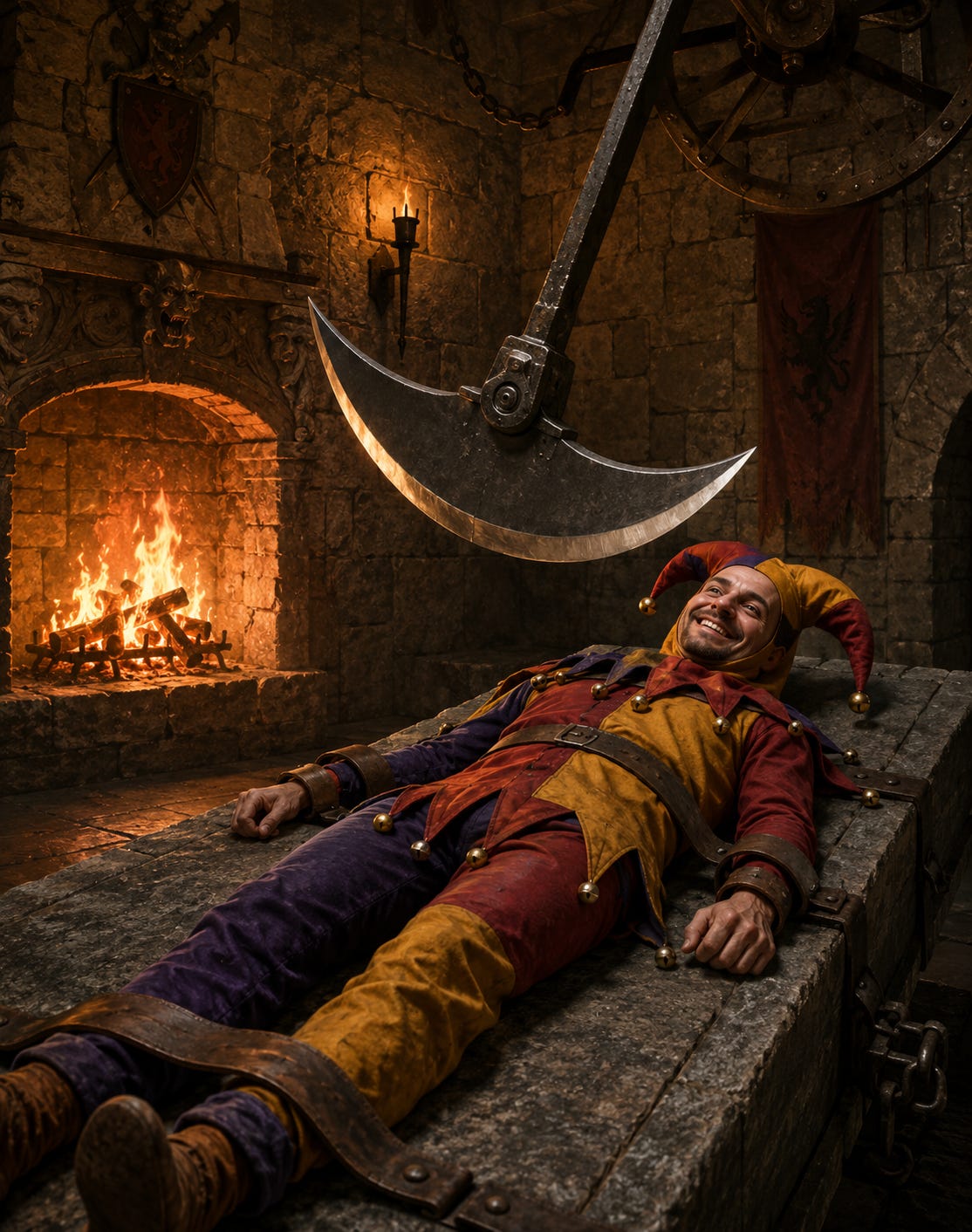
Sometimes, before you get a blinding, terrifying insight, you have to feel the sopping wet toilet paper. If you know what I mean.
Okay, you don’t know what I mean. Consider:
It was a full, unused roll, and it lay in the bottom of a closet in the basement. Why was it wet? Come to think of it, why was the towel beside it wet, too?
I called a plumber. The plumber came. Turns out there was a leak from a water pipe behind the closet wall. The plumber had to bust down the drywall to get to the wet pipe. But to bust down the drywall, he first had to bust down the heavy shelving that the drywall was holding up. These things he did. Then he repaired the pipe and left. That left me with drywall to be replaced and shelving to be re-installed. I am about as handy around the house as a mosquito. But the plumber gave me the name of a handyman. It was his Uncle Charlie.
Still with me? The blinding scary insight is coming.
Uncle Charlie arrived the next day. He’s 60 years old but looks 40. He’s got a work-hardened build. He runs his business out of his truck.
We bonded as soon as he looked out my back door and saw my tomato plants. “I have 22,” he said. “I have 28,” I said. He whipped out his phone to show me pictures — not of his kids, of his tomato plants. We both are committed urbanites with small cement backyards. Urban gardeners are tough. We share a fierce bunker mentality.
Uncle Charlie got to work. He was great. Took him about two and a half hours to rebuild the closet. Then he asked about any other jobs I might need done, so he replaced and repainted some rotted wood at the base of a doorway, patched an old water-leak hole in a ceiling, and gave me four light bulbs, because I needed them. Then he threw in some advice on what type of fan to get for the attic. Charlie’s bill was $450. I wrote him a check for $500. He was that good.
After he left, my left eye went nuts. I saw a weird flashing light — it looked like an evil neon zipper, and it interfered with the vision out of that eye. It seemed like a retina is detaching, which can cause blindness. Fortunately, I already knew what it was, and it wasn’t that.
It happens about once a year to me, and has been happening about once a year for a quarter century. After many visits to many doctors, it was diagnosed as an odd, painless, mostly harmless condition called an “optical migraine” that lasts about a half an hour and then goes away. It’s caused by a hiccup in a retinal capillary.
Anyway, this gave me an idea. I am fascinated with, and terrified of, Artificial Intelligence. I know it is supposedly adept at medical diagnosis. So I decided to test it. I told it about my electrical zipper, and asked what it meant. I did not tell it that I already knew.
In two and a half seconds it diagnosed the thing perfectly. But it also told me something no doctor had: There are two versions of this condition, one of which is a bit more dangerous than the other. It suggested a simple test to identify which version I have. As it turned out, I had already instinctively done this test on myself, but without understanding the meaning of the results. AI informed me I have the less dangerous kind.
(The blinding insight, as it were, is just a few short paragraphs down.)
I was grateful to AI, but kind of freaked out. I just like it better when humans solve human problems, you know? And then I thought of something to make me feel more secure.
This was my next question to ChatGPT. I identified myself as an amateur expert in mechanical clocks, which I am:
“Make up a joke about Galileo discovering pendular motion. It would be best if it is slightly dirty. Risque, not filthy.”
As always — always, however complex the challenge — ChatGPT answered in two and a half seconds.
In 1583, Galileo Galilei famously noticed the regular swing of a chandelier inside the Cathedral of Pisa.
That evening, he rushed home to his mistress, Marina Gamba, bursting with scientific excitement. He grabbed her hands and exclaimed, "Marina! I have made a monumental discovery today in the house of God! I watched a heavy mass swinging back and forth, and I realized that no matter how wide the arc, the time it takes to complete one full stroke remains absolutely constant!"
Marina looked him up and down, sighed deeply, and said:
"Well, Galileo, that certainly explains why you always finish in exactly two minutes... but I really wish you wouldn't use physics to justify a lack of acceleration."
This was no worse — and maybe better — than I could have done, and it would have taken me a lot longer than two seconds. Maybe I never would have gotten there at all. And that is when I got blinded.
I think the future of humankind might belong not to people like me, but to people like Uncle Charlie. There is no shame in this, no great unfairness. He does excellent, precise work for which he charges fairly. And it is work that cannot possibly be replicated by a machine, at least not any time soon. A machine might eventually be able to out-diagnose the greatest doctor, or even absorb enough of the complexity of the human condition to be able to be better than Shakespeare, or, say, to somehow commingle The Bard with Dylan and Sappho to produce the deepest, most versatile literary works ever “written.” Or be funnier than Richard Pryor or, um, me. With that last tick, it might already be there.
But in this new world inhabited by humans but run by machines, Uncle Charlie will be safe, and more power to him. To all of them. To child-care workers. To police officers.
It will be a fundamental restructuring of human worth. There will be vast amounts of elitist whining, and the pretentious arts will suffer enormously. But exactly how much worse will things be than they are now, really?
—
Hey, my pal and former journo colleague Richard Leiby was offered $240k a year to work for AI, and turned it down. He writes about it here, in his Substack. I, Robot? No Thanks. It is fascinating.
Today’s Gene Pool Gene Pool:
—
And finally, since this is The Weekend Gene Pool, please send in your thoughts / experiences about the subject of this column, and of the poll above. Send, as always, to the Mailbag.
Also, please save me and other human writers from starving. You will like your new overlords even less.
And yes, the error in the Poll was deliberate, to distinguish it from AI.
AI like most technology is a mirror. What we see in it depends on what we bring to it. I suggest AI can make us more human, but not by being human‑like. It makes us more human by being decisively not human. Because when you’re talking to something that has: no ego, no social anxiety, no desire for status and no fear of embarrassment…it becomes painfully clear which parts of our behavior are uniquely, beautifully, frustratingly human — and which ones we might want to upgrade. So, AI can make us more human. But if we don’t rise to the moment, it can also make us less human — not by force, but by convenience. The future isn’t a battle between humans and machines. It’s a battle between humanity at its best and humanity on autopilot.