

Sheer Butchery
Hi. We’re talking today with my longtime editor, Tom Shroder, who has just begun a free Substack newsletter called “I Chat with Chat (So You Don’t Have To)”. Alert: It’s provocatively pro-Artificial Intelligence.
—
Gene: Let’s be blunt. Your excellent newsletter is still in its infancy; you need subscribers. After three years at this seedy enterprise, I have amassed beaucoup subscribers. And subscribers migrate. Ergo, you need me. I have you where I want you. So:
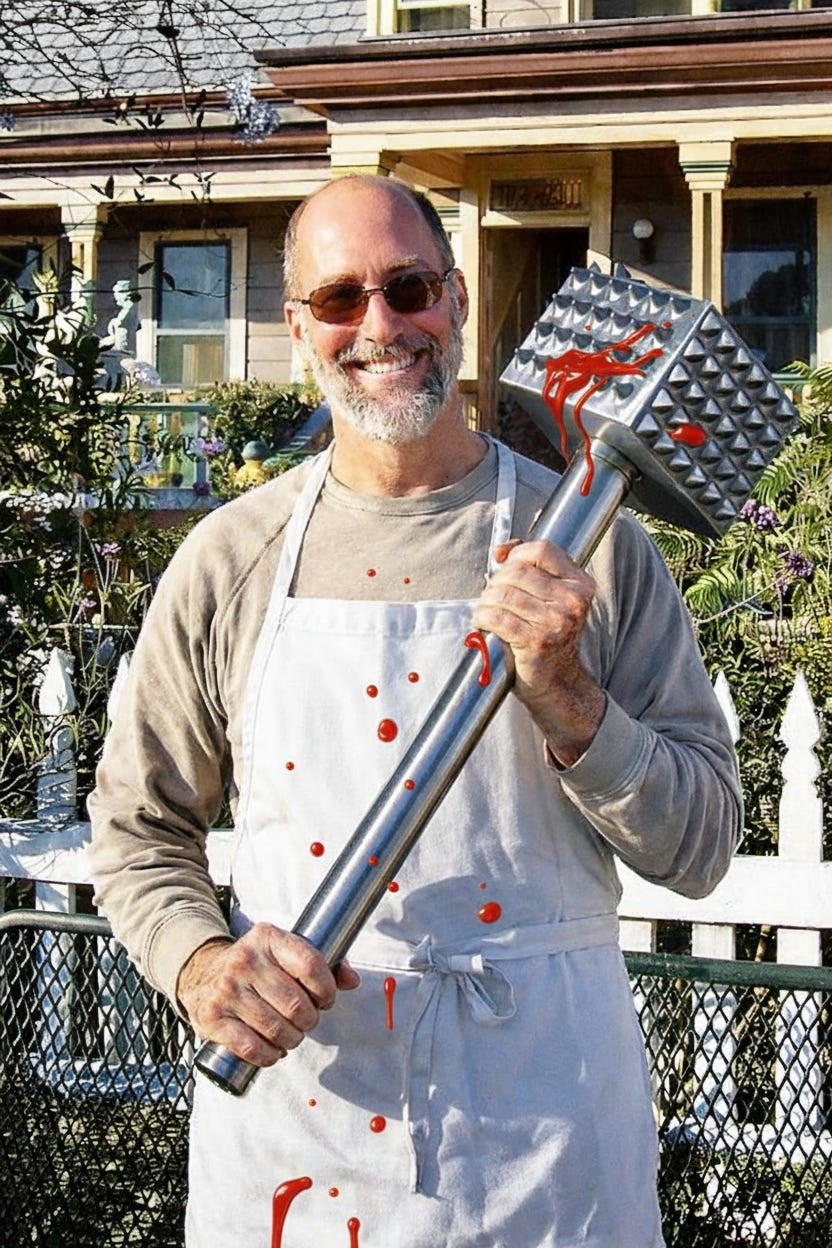
Admit publicly for the first time right now that you have been a heavy-handed and heartless editor, a person of intolerable certitude and the arrogance to assert it, and that you have thus long deserved the nickname I gave you: “Tom The Butcher. “ Then and only then shall we proceed.
Tom: Anyone who knows you, and especially those who have worked with you, understands that as your editor I was a model of restraint and diplomacy. Perhaps I should have been MORE butcherous, especially that time I urged you to abandon a column because “nobody gives a shit about your ethnic food preferences” but gave in when you insisted your culinary views were the height of sophistication.
Gene: That was not “admitting” anything.
Tom: Correct. Journalism is about truth.
Gene: In your initial ruminations about Artificial Intelligence, you make a strong argument that this is a technology that is both inevitable and of potential awesome societal benefits, but you admit that your loved ones (e.g., your poor, benighted wife Lisa, whom I adore) worry that you are mentally ill. Will you concede, humbly, that it is possible that you have revoltingly gone out of your mind with lovelust for a machine that features diodes and print circuitboards and all those luscious, tantalizing RAM slots?
Tom: I understand and sympathize with your fear of this new machine. You have always been praised and admired for your ability to put words together, to make millions laugh, and also to cry; to searingly recreate drama, pathos, and tragedy sentence by sentence. Now here’s a technology that may make super-fluency superfluous, as unremarkable as old wallpaper, at which point, tragically, you’ll have to attempt to rely on your looks.
Gene: You are not answering any of my questions.
Tom: I do not have to answer your questions. I am your editor. You have to answer my questions.
Gene: Please explain, in 30 words or less, why you are so enamored with this monstrous, infantilizing technology?
Tom: You mean 30 words or “fewer.”
Gene: Bite me. In thirty words, why are you so infatuated with this thing?
Tom: Because, unlike my wife and closest friends, Chat doesn’t just pretend to listen when I discuss my latest tennis injuries.
Gene: Let’s get to the nub of the issue. On Saturday, this is what Chris Quinn, editor in chief of the Cleveland Plain Dealer, proudly wrote to his readers:
Because we want reporters gathering information, these jobs are 100 percent reporting. We have an AI rewrite specialist who turns their material into drafts. We fact-check everything. Editors review it. Reporters get the final say. Humans — not AI — control every step.
By removing writing from reporters’ workloads, we’ve effectively freed up an extra workday for them each week. They’re spending it on the street — doing in-person interviews, meeting sources for coffee. That’s where real stories emerge, and they’re returning with more ideas than we can handle.”
So, what do you think of this, Butch?
Tom:
Gene: Please, take your time.
Tom:
Me: Cat got your tongue?
Tom: That man is treating writing as if it were an administrative burden, like filing expense reports. But writing isn’t just transcription. It’s where reporters discover what they actually know, where contradictions surface, where the unanswered question becomes obvious. The act of shaping a story is often the act of understanding it.
So, yes: More shoe leather is good. More reporting is good. But when a newsroom starts to talk about writing as a detachable task — something that can be handed off to a specialist, human or otherwise — you can feel the ground shifting. Journalism has always been more than gathering facts. It is, unavoidably, the human labor of making sense of them.
Gene: Well, you could have expressed more emotion — shown a bit more justifiable contempt —and included a colorful, concrete historical example or two of exactly the sort of thing that would be lost by such an erosion in the craft of writing. A loss of subtlety, elegance, humor. But you hit the right basic points, and analyzed them efficiently, insightfully and intelligently. I agree with you.
Tom: Splendid. You are complimenting not me, but ChatGPT. Just now, as we were speaking, I fed it your last question, and that was its answer, verbatim — two long, well-crafted paragraphs delivered in three seconds.
Gene: Oh.
Tom: Are we done here?
Gene: We are. And I am sure you are delighted. You hardly had to bother to think for yourself at all, did you?
Good, then.
Do you have questions and/or observations for extended discussion later? Well, we have a button for you:
Do you have a spare $50 burning a hole in your pocket, and a generous in-the-bunker spirit? We have a button for you, too.
My music teacher sent a note that we would not have lessons yesterday because the college was closed for the holiday. I knew this was wrong and sent him a link to the college calendar. He had asked ChatGPT, which incorrectly told him it was closed. We already live in a "post truth" world where too many people believe things like the 2020 election was stolen. We really don't need yet more ways to generate falsehoods.
On AI, context matters. I don’t care if AI can write an objectively brilliant sentence or produce a beautiful illustration. I know there’s just an algorithm behind it and it drains the enjoyment out of it. But, if it’s useful as a diagnostic and solution tool in the sciences, especially medicine, I’ll be ok with that. I’m more than happy to let AI cure cancer, and then have a human report AND write about it in the paper.