

Plummeting Fortune
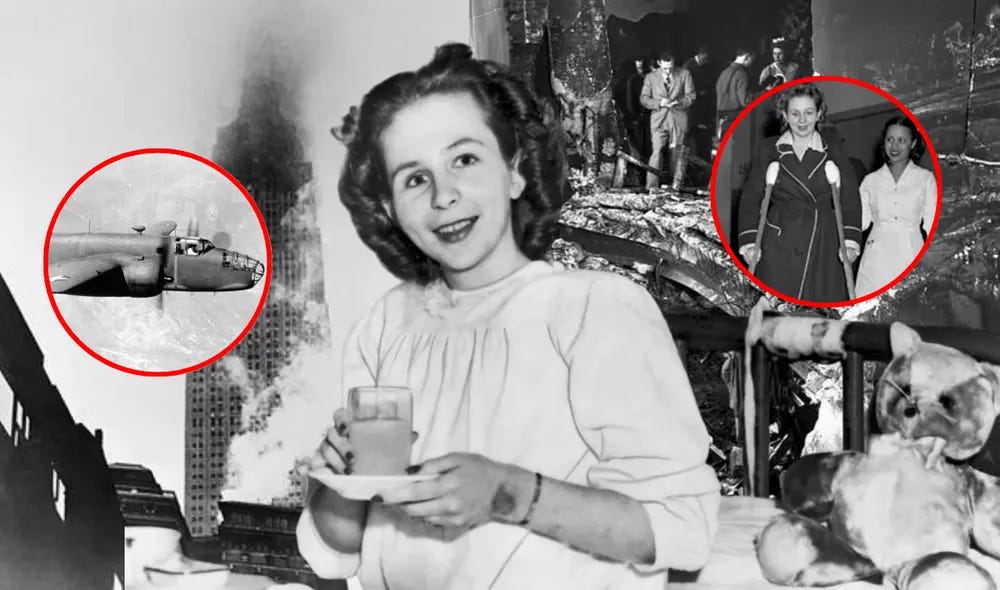
At 9:39 on the morning of Saturday, July 28, 1945, 20-year-old Betty Lou Oliver had just started her shift as an elevator operator at the Empire State building in New York. It was her last day on the job, a job she got as a wartime replacement for a man. The war, after all, was drawing to a close. Just nine days later, an atomic bomb would obliterate Hiroshima, also taking with it most memories of the improbable, incredible story of what happened to Betty Lou that day at 9:40 a.m. It became old news real fast.
So here it is. I found it when combing through old news clips online, to try to bring a sense of historical proportion to yesterday’s tale of the two young trespassing daredevil lovers who defied death and the laws of the State of New York and climbed the spire of The Empire State Building and kissed at the top, as a gesture for world peace and, y’know, concupiscence.
Betty Lou’s story is better.
At 9:40 on that morning in 1945, a B-25 bomber, just returned from war duty, got lost in a heavy fog. It nearly clipped the Chrysler building but the pilot, realizing his peril at the last second, put the plane into a sharp stall-climb and just escaped the building’s Art Deco scalloped sunburst spire. Unfortunately, the Empire State Building, just ten blocks away, was a lot higher. The plane plowed into it right near the top, between the 78th and 80th floors. This is what it looked like seconds later.
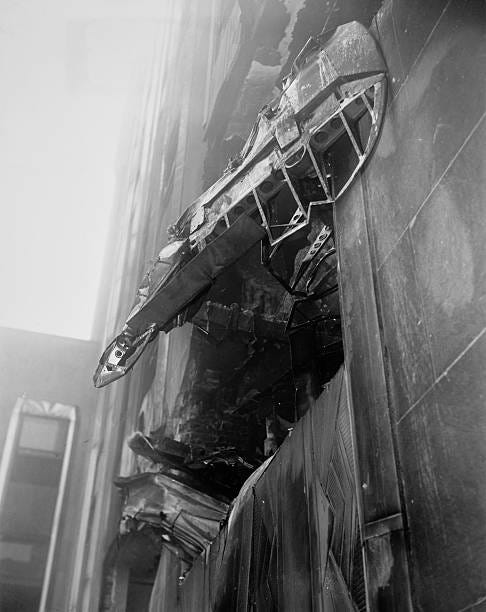
The three men in the plane died on impact, as did 11 people in the building.
At the moment the plane hit, Betty Lou was in her elevator, its doors open, on the 80th floor. The blast threw her out of the car, across the hall, and into a wall. Fire from burning fuel filled the corridor. Betty was badly burned. Shrapnel had gashed her limbs.
Rescuers reached her quickly, battlefield-treated her burns, and then put her onto a gurney and into another elevator, elevator six. The workers had other grievously injured people to attend to. The elevator was an early push-button model. The rescuers hit the button for “lobby” where an ambulance team awaited. The door closed.
And that’s when Betty Lou Oliver stepped into human freaklore. No one knew it, but debris from the plane had severed that elevator’s cables — all eight of them.
There was a fail-safe mechanism — an overspeed governor — on Elevator 6, primed to apply emergency brakes the minute a descending elevator deviated from its normal speed. But that system failed, likely because the overspeed cable — connected to a flywheel — was also severed. So as soon as the doors closed, the elevator went into near free-fall.
Betty Lou screamed.
—
A few months later, the world would learn of the grotesque story of the Nijū Hibakusha, people who survived the Hiroshima bombing and then traveled to Nagasaki just in time to survive the second bomb. Betty Lou Oliver collapsed that story of breathtaking irony and macabre mixed-blessing luck into a two-minute storyline.
In the elevator, Betty Lou was fighting not to slam into the ceiling of the car: "I was going down so fast,” she later told an interviewer, “that I just had to hang onto the sides of the elevator to keep from floating." This might be one of the earliest examples, in the pre-space era, of any civilian describing weightlessness from actual experience.
Yes, she lived. She still holds the Guinness Book record for having survived the longest elevator plummet ever.
How did she do it? Three things, it is theorized, saved her:
The first was that there was cable above her elevator box, but much more below it, since she was high up in the building. As she fell, so did the cable, and when Betty Lou hit bottom, the bottom was a tangle of steel cabling, acting as an enormous coiled spring, like springs from a mattress.

The second thing that helped save her was the gurney. It also collapsed under her.
The third thing that saved her, and the most important thing, was science — specifically, a branch of fluid dynamics called pneumatic damping or, more familiarly, air cushioning. As the elevator falls, it acts like a giant piston inside a cylinder, rapidly compressing the air. The air pressure rises way above atmospheric pressure, meaning it’s applying an upward force, meaning it is slowing that elevator down significantly.
Betty Lou did not hit the ground with the same force she would have had she, say, leapt from an 80th floor window. Judging from the extent of her subsequent injuries, she seems to have hit is as though she had leapt from a fifth floor window.
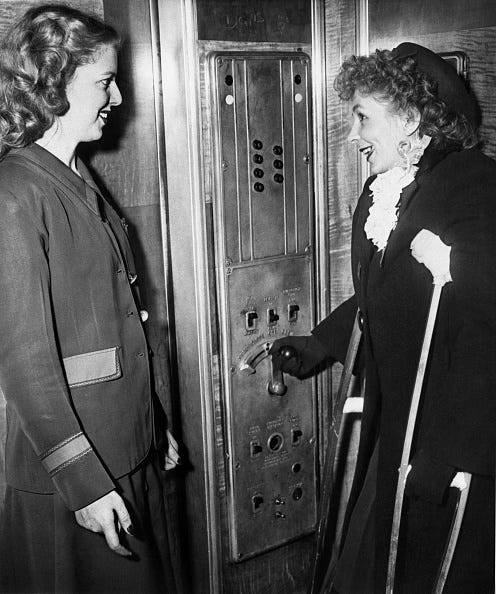
Her pelvis was broken. Her spine was fractured. But within five months, she was up and walking on crutches and even took a trip to The Empire State Building, where she gamely rode all the way to the top in an elevator, accompanied by an elevator inspector.
Here she is, visiting the building.
Here she is with her husband, Oscar Oliver, who was a U.S. Navy torpedoman during the war.
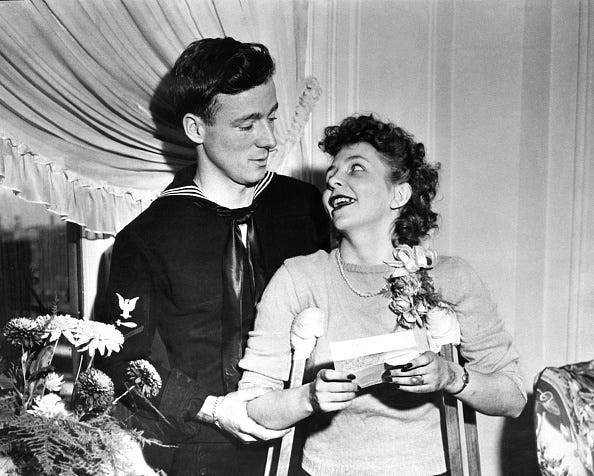
Here’s another with Oscar. And there’s the big hole, on the right.
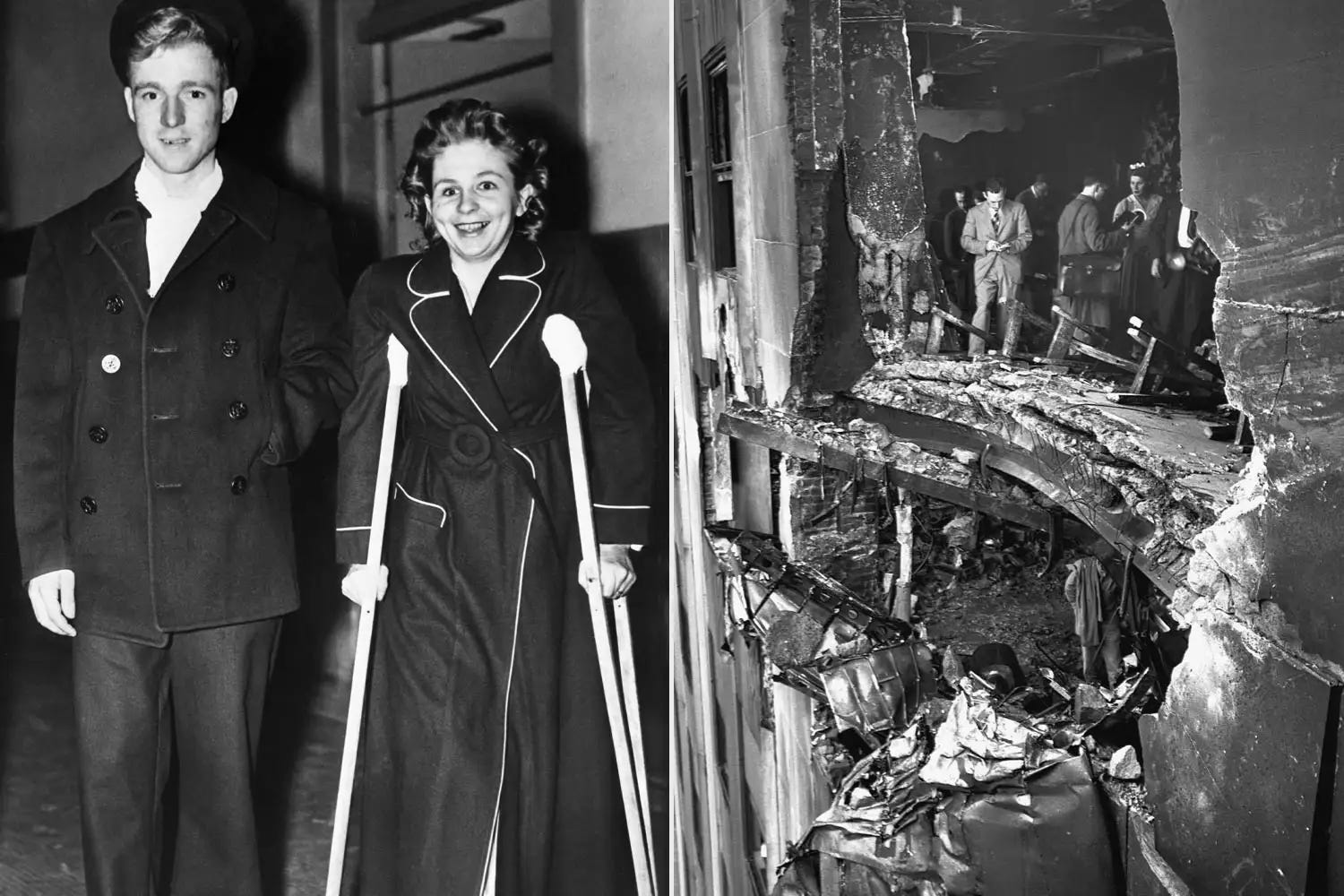
Betty Lou and Oscar moved to Fort Smith, Arkansas, shortly after he returned from the war. They had three children and seven grandchildren, and remained married until Oscar died in 1986, at 61. Betty Lou died on November 24, 1999, at 74, in Fort Smith.
—
There is one lasting mystery about her story.
For years, Betty Lou declined to profit from publicity. She assiduously avoided the limelight. She gave no interviews. She seemed embarrassed by attention. There are no photos of her publicly available from later than 1946.
But in 1977, she was interviewed by a man named Arthur Weingarten (no relation!) for a book he was writing about the crash. It was titled “The Sky Is Falling.” In it, Betty Lou politely contested a central part of her story, as was widely reported at the time and has been repeated over the years. It is pretty much the story you have just read, here.
But in 1977, Betty Lou said she never was thrown out of her elevator, never was ministered to by rescue workers. She said she was riding in her own elevator when the plane hit, and it plummeted to the ground seconds later.
Whoa. What are we to make of this?
It is very likely a false memory, born of the amnesia sometimes associated with trauma. Her recollection would not account for the burns she sustained, or for the shrapnel. It would not account for the discovery of the gurney in the crashed elevator. It would not account for the contemporary interviews with eyewitnesses, including the rescue workers themselves. It would not account for the fact that Betty Lou never said anything like this in the 30 years before that interview.
But it’s interesting. That’s what we do here, in The Gene Pool. We aim for interesting.
—
Today’s Gene Pool Gene Poll:
While not directly comparable, it's interesting how the Empire State Building survived the bomber crash pretty much intact while the Twin Towers did not survive the commercial plane crashes. According to reports, part of it had to do with construction: the ESB is a traditional steel frame encased in thick masonry and reinforced concrete for a very high level of structural redundancy, while the Towers utilized a lighter, innovative "framed-tube" design. This maximized open floor space by transferring the load to the perimeter columns and a central core, although making the structures far more vulnerable. Obviously, you don't normally design buildings to withstand plane crashes. But what caused the eventual collapse of the Towers was the enormous volume of jet fuel generating a conflagration with temperatures exceeding 1,500°F, weakening the floor trusses and steel columns until they could no longer support the weight above them. By comparison, the B-25 had a very much smaller fuel load and the resulting fires on one floor were contained quickly.
Thank you for writing about Betty Lou. Despite the terrible fall and subsequent injuries she went on (it appears) to live a fulfilling life showing us we can overcome tragedy. Let’s keep that in mind during the trying times of this regime. Oh, and her courage to return to the elevator and that beautiful smile! Brava Betty Lou!