

Ike v. Tyke
History doesn't always echo. Sometimes, it mocks.
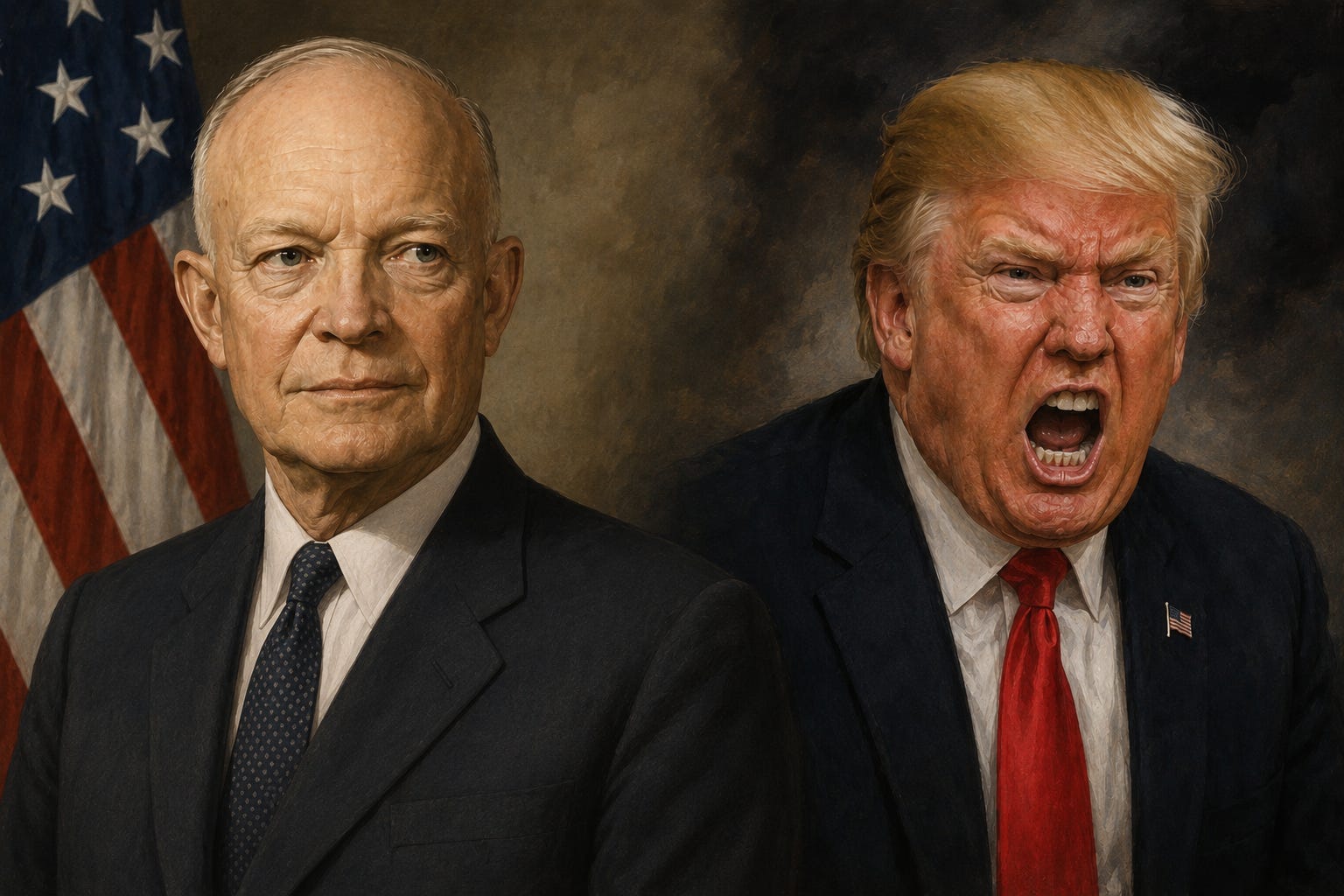
On this day 66 years ago, Dwight Eisenhower confronted a problem. It was an enormous problem, a humiliating one, and it was of his own making.
Ten days earlier, the U.S. government reported that one of its aircraft, a U2, had “gone missing” near the Russian-Turkish border, apparently the victim of mechanical failure. It had been a “weather research plane,” President Eisenhower said, operated by NASA. It had veered off course.
This was a lie. It was a spy plane, operated by the CIA, engaged in illegal photographic reconnaissance over Soviet airspace. After the Soviets didn’t initially respond forcefully to this cover story, the U.S. government threw itself thickly into the deception, even quickly painting a similar spy plane in the colors of NASA, and photographing it for public release. Most Americans believed their president, of course. These were the days when Americans reflexively accepted what their leaders said. It was before the Pentagon Papers, and before Watergate, and, most to the point, it was before Donald Trump.
The weather plane cover story lasted just nine days more, when Nikita Khrushchev sprang his trap. The Soviet leader gleefully addressed his country — “I must tell you a secret….” — and revealed that the pilot, Francis Gary Powers, was alive and well and (presumably) talking, and that Soviet soldiers had recovered the aircraft with its sophisticated surveillance equipment.
These facts now became undeniable; it was a gigantic Cold-War propaganda coup for the Soviets. On May 10th, a shaken Eisenhower whispered to his secretary, “I would like to resign.”
He didn’t. The next day, on May 11, in an intense and somber news conference, Eisenhower accepted responsibility (not the blame) for the lie, and for the spy flights — there had been four -- and detailed it all to the nation in elegant, understandable, terms. He was not self-righteous; he was righteous. His speech — as embarrassing as it seemed at the time — was true and blunt and unsparing. It was as fine an example of statesmanship, and grace under pressure, as had ever issued out of The White House. This was the scene:
Eisenhower began by saying he had four points to make, but needed to precede it with this startling statement:
“After that I shall have nothing further to say--for the simple reason I can think of nothing to add that might be useful at this time.”
Everyone in the room understood what he meant: He would accept no questions about the subject. Everyone, in fact, would adhere to his request, as though for an understood common good, in furtherance of a common patriotism. Many questions followed, not a single one of which directly related to the incident. Nothing happened that day to suggest media skepticism or government stonewalling. This comity was both good and bad, of course — it was, perhaps, naive — but it was, above all, gentlemanly. (Alas, almost everyone in the room was male.)
Ike’s first point was to emphasize the need for intelligence-gathering in a terrifying new world.
“No one wants another Pearl Harbor. This means that we must have knowledge of military forces and preparations around the world, especially those capable of massive surprise attacks.
“Secrecy in the Soviet Union makes this essential. In most of the world no large-scale attack could be prepared in secret, but in the Soviet Union there is a fetish of secrecy and concealment. This is a major cause of international tension and uneasiness today. Our deterrent must never be placed in jeopardy. The safety of the whole free world demands this.
“As the Secretary of State pointed out in his recent statement, ever since the beginning of my administration I have issued directives to gather, in every feasible way, the information required to protect the United States and the free world against surprise attack and to enable them to make effective preparations for defense.
“My second point: the nature of intelligence-gathering activities.
“These have a special and secret character. They are, so to speak, “below the surface” activities.
“They are secret because they must circumvent measures designed by other countries to protect secrecy of military preparations.
“They are divorced from the regular visible agencies of government which stay clear of operational involvement in specific detailed activities.
“These elements operate under broad directives to seek and gather intelligence short of the use of force--with operations supervised by responsible officials within this area of secret activities.
“We do not use our Army, Navy, or Air Force for this purpose, first, to avoid any possibility of the use of force in connection with these activities, and second, because our military forces, for obvious reasons, cannot be given latitude under broad directives but must be kept under strict control in every detail.
“These activities have their own rules and methods of concealment which seek to mislead and obscure--just as in the Soviet allegations there are many discrepancies. For example, there is some reason to believe that the plane in question was not shot down at high altitude. The normal agencies of our Government are unaware of these specific activities or of the special efforts to conceal them.
“Third point: how should we view all of this activity?
“It is a distasteful but vital necessity.
“We prefer and work for a different kind of world--and a different way of obtaining the information essential to confidence and effective deterrents. Open societies, in the day of present weapons, are the only answer.
“My final point is that we must not be distracted from the real issues of the day by what is an incident or a symptom of the world situation today.
“This incident has been given great propaganda exploitation. The emphasis given to a flight of an unarmed nonmilitary plane can only reflect a fetish of secrecy.
“The real issues are the ones we will be working on at the summit-disarmament, search for solutions affecting Germany and Berlin, and the whole range of East-West relations, including the reduction of secrecy and suspicion.
“Frankly, I am hopeful that we may make progress on these great issues. This is what we mean when we speak of “working for peace.”
—
Gene Pool Gene Poll:
Can you imagine how this whole thing would have played out had it happened today? Today, when Americans — sifting for the truth in an abattoir of lies and deceptions — seem more inclined to take the word of the Iranian ayatollahs than the president of the United States? Can you imagine how the infantile, congenitally duplicitous, vindictive egomaniac in The White House would have handled this?
In 1960, here is what happened afterwards:
A week later, there was to have been a scheduled summit conference between Khrushchev and Eisenhower. It broke up in disarray when Eisenhower declined to apologize to Khrushchev. The world again seemed on the brink of war. But the United States did not come away from this debacle humbled. It seemed pragmatic, focused, and strong.
The pilot, Francis Gary Powers — who was sometimes maligned as a coward in the U.S. media for having not used a suicide dart he’d been supplied with — was convicted of espionage in the Soviet Union and sentenced to ten years in prison. Two years later, Powers was traded for convicted Soviet intelligence agent Rudolph Abel, with the prisoner exchange occurring on the notorious Bridge of Spies. Powers returned to the United States and took a job as a helicopter pilot for a TV station.
He died on August 1, 1977, at the age of 47 when the news helicopter he was flying crash landed in Encino, California, while covering brush fires. The accident appears to have been caused by a faulty fuel gauge. In the last three seconds of the crash, Powers is believed to have steered his dying, spinning copter away from a group of kids playing baseball. He corkscrewed into the ground 50 yards away from them
Mr. Powers is buried in Arlington National Cemetery.
—
That’s it for today.
And, finally, if you are of a mind and have the means, please consider becoming a paid subscriber to this here newsletter, which, in the words of Woody Guthrie describing his guitar, “is a machine that kills fascists.”
Note: The underline to the headline atop was written by the always excellent Ron Fournier.
I didn't feel any of those three options. What I felt (putting myself in the context of the time) was reassured. I trusted what he was saying. I didn't immediately jump to the conclusion that he was lying. The whole speech seems honest - "I can tell you these things, I cannot tell you these other things." I can't think of a single politician right now that I trust not to lie, except maybe Bernie and Mark Kelly.
The current GOP would run from Ike.