

Artificial Outrage?
Nah. It's real. But so is Artificial Intelligence, alas.

Imagine a terrible scenario: Your child is exhibiting disturbing medical symptoms. Your family doctor says you need to consult the best neurologist in the country, then helps you get an appointment. You go, with your child.
The doctor begins by outlining her diagnostic process: After lab work and physical examinations, she says, she will discuss your child’s case with her most experienced colleagues, then consult her medical library, which includes … Artificial Intelligence.
You recoil at this. The doctor nods sympathetically, then smiles. The computer, she reassures you, is sometimes laughably wrong, and she says she ignores those things. But sometimes, she says — more often than she’d expected — after surveying decades of research all over the world, AI suggests non-intuitive but plausible scenarios the doctor hadn’t thought of. These insights can be life-saving. Because of this potential benefit, she says she would consider it malpractice not to consult AI, as one of many sources, before settling on a patient’s treatment plan.
Okay, we got that over with. Now let’s talk about me.
Of late, I’ve gotten some critical comments from readers because I sometimes use an AI-generated illustration in my column. Usually, I use it as a weapon against itself, to ridicule how shoddy AI can be. I am one of its rudest detractors. I think the public needs to know how reckless and threadbare some of its applications are. But I have also used it to generate a quick, compelling image on deadline, on an unrelated subject altogether. When properly instructed, I have found, AI can produce professional-looking art in an instant. I use it for that purpose, as sparingly as I can.
This is one I ran the other day.

It accompanied my column urging New Yorkers to robustly boo Donald Trump at the NBA finals. It was my idea to turn The Round Orange Man into a basketball, and to have one fan pointing a “#2” finger at him. AI did a more than serviceable job at turning this into an illustration. For competitive reasons this column had to get out minutes after I wrote it, and I felt I had no reasonable alternative if I wanted exactly that image, which I very much did. It made the column more noticeable. More people read it than would have otherwise.
Still. A few readers did not like that I did this, at all. (And, no, not a one of them was offended on behalf of Trump.) Those readers were ungenerous in their assessments. The complainers were not stupid, and they were earnest and consistent in their position, but they did tend to be absolutists: AI is bad, I know it is bad, I use it sometimes, ergo, I am bad.
To state the obvious, this debate does not present the same risk-reward calculus as the potential life and death of a child. But the basic ethical conundrum is the same, and the charge of hypocrisy hangs heavy, whether stated or unstated (some were stated). So, at the peril of further infuriating the already furious, I’d like to take this on.
Imagine you are living in the 1890s. Electricity has just been harnessed. People are mighty suspicious of it! They think it a dangerous, unnatural, even supernatural force. They fear its power. Respected medical people opine that it might destroy our sleep cycles and rewire our nervous systems. President Benjamin Harrison is said to have refused to turn on the lights in the newly electrified White House because he is afraid of being sizzled to death if he touches the wall switch. There is a familiar corporate conspiracy element, too. People resent and deeply distrust the new titans of electricity, Thomas Edison and Nikola Tesla, who are broadly considered to be scheming, would-be mad-scientist monopolists.
(This is all true.)
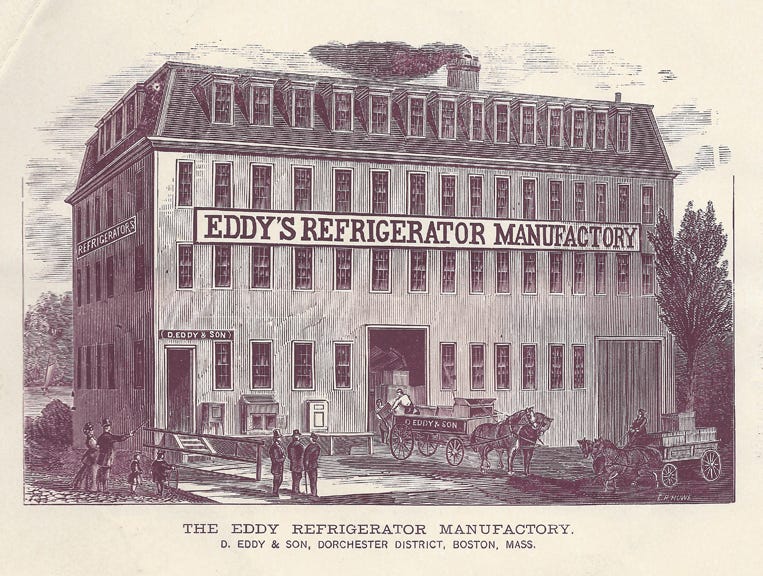
Now, imagine you were a craftsman who made iceboxes back then. Let’s say you were Darius Eddy, of Boston. Darius was a stagehand-carpenter who dared to think big by branching out to manufacture the finest iceboxes in the world, mostly made out of sturdy pine. He called them “refrigerators,” but they were iceboxes. D. Eddy & Sons iceboxes became famous: Their factory looked like this:
Their products looked like this:

Gorgeous, no? Handcrafted. Elegant. Fine wood, brass and bronze fittings. They were lined with tin to house the giant blocks of ice for when the iceman cameth with his adorable tongs.

Then. electrification hit. Actual electric “refrigerators” came on the market.
Darius Eddy and his sons didn’t cotton to that modern gizmo one little bit. It was the devil’s work. The company declined to modernize. It went belly up. In its final years, there were a series of suspicious factory fires there. It looked like an attempt to liquidate for insurance. The iceman goeth.
These wonderfully crafted old ice boxes now sell on eBay for good money — useless but stately antiques. They’re a resting place for potted plants. A remnant of an overly gullible past.
Bear with me. The analogies will come together. They always do.
As you know, I mistrust AI. But I also know that its proliferation is inevitable. We cannot wish it away, or will it away, or boycott it away. To throw it away would be unwise — it’s an extraordinary, supple technology whose medical applications alone promise to be life-changing. Its creative applications are … complicated. Daunting.
What we should do, I think, is regulate the shit out of it — perhaps make it a publicly owned utility. And I think we need to personally adapt to it according to our own moral codes, and be judged in the human marketplace on how we choose to use it.
Here’s how I think of it. Ethically, we all dwell on a continuum. For example, I eat animal flesh. I feel guilty about eating animal flesh. If I were a more moral person, I probably wouldn’t eat animal flesh. I deal with this unsettling situation as best as I can: I don’t consume animals that have been cruelly farmed. I pay more for animals that have not. I won’t eat foie gras, because of cruelty. Or octopuses, because they are geniuses. (I will eat squid, because they are idiots.) I buy only cage-free eggs. There is a situational hypocrisy in all of this, but it is a human hypocrisy, and we all live with those to one degree or another. Perhaps you fudge a little on your taxes. I don’t.
Many writers robustly and unapologetically use AI. I do not. I don’t use it to help me come up with ideas, or even hone ideas I already had. I don’t use it to rewrite my work. I try not to judge people who do. We live in complicated times.
Some of the best-known Substack writers don’t use AI at all. Others use it all the time. I am okay with both choices. There’s a slope here, and I don’t know just how steep it is, yet. Or even where it begins.
I am writing this in part because of a particular letter I got. It was from a very smart guy. Very thoughtful. Very passionate Very judgmental. A bit naturally nitpicky. He has several times in the past complained in Comments about some typo I made. I don’t begrudge him that. I like engaging with him.
But it raises an interesting point. I am susceptible to occasional typos: Should I use AI to find them before publication? It’s really good and quick at that. It takes no cerebration, no theft of others’ work — it’s like a more sophisticated spellcheck. Is that okay, Mr. Letterwriter, so you will be less disappointed in me?
For that matter, is it okay to use an AI-generated piece of art that was already out there on The Web, first reproduced elsewhere? Is that bad, too, like buying old ivory wrenched from the jaws of long-dead elephants, or furs made from animals killed in the Roaring Twenties? Is it like secondhand smoke? Where do we stand on that?
A slope. How steep?
Okay — but what about what is happening to the careers of talented illustrators?
That weighs on me, too. I am in awe of good artists and have no idea how they do what they do so flawlessly. Some of my closest friends and colleagues are illustrators and cartoonists. When I was an editor, I regularly looted my corporation’s budgets to pay illustrators handsomely for what these people did. In the field, I was known as a lavish spender on original art.
We live in a different world now. Big-budget media is disappearing. Legacy media is selling its soul. Some of the most important truths are being told today by self-employed, lonely pamphleteers. Most of these people don’t make much money. They couldn’t pay for good human illustrators and stay afloat.
I can still pay creative people for their work. I just cut a check for a very talented woman who recorded a video for The Gene Pool. I just paid for an old photograph that perfectly illustrated one of my columns. I probably could have stolen it — it was on the Web, for sale but copy-able — but I’m not a thief. (I think.)
I do not believe I am sometimes using AI instead of hiring pros. I am using AI because it is logistically impossible to hire these people for the purposes I need. They are, generally, not an option.
Some critics suggest simple nostrums involving planning better, writing columns more in advance, to give illustrators the time they need to do what they do. I usually cannot do that. This is an unforgiving new battlefield that thrives on being instantly reactive. The more self-righteous critics suggest deliberately sacrificing the quality of your product for the purity of your process. I actually find myself making that decision frequently — but isn’t there a line? Isn’t there a noble compromise? Shouldn’t there be?
I do think there is a Darius Eddy point. I don’t want to become obsolete. I don’t want to have to burn my house down for the insurance money.
—
That’s it for today.
Like so much else these days, you're really talking about moral purity when it comes to AI --- the secular version of the old theological idea that there is something sacred about human activity that must not be contaminated by the artificial. But this is where the hypocrisy comes in --- people rarely apply this purity logic consistently. Most didn't invoke moral purity when: ATMs replaced bank tellers, GPS replaced mapmakers or spellcheck replaced proofreaders. So, not so much "morality" as class politics wearing a moral mask. The purity argument collapses because humans have always outsourced parts of themselves: memory to writing; navigation to maps; calculation to machines and perception to sensors. AI is just the next outsourcing. The discomfort isn’t really about morality --- it’s about proximity. And as I've said before, the core issues are what parts of our cognitive makeup (individually and collectively) we're willing to outsource to AI and their social and economic consequences.
In addition to all the moral points around replacing human effort (which Dale of Green Gables has answered well, here, already); it is the energy/environmental impact that troubles me. None of the historical analogies carried the global climatic impacts that this new technology does, and it's not at all clear how we will handle that.
There are two parts to this: Training, and Using AI LLMs.
TRAINING
The training run for just one recent iteration of ChatGPT from Open AI (only one of many LLMs by multiple corporations) is estimated to have required about 11 BILLION kilowatt-hours (kWhr) of electric energy. Just to train it, before use. Is that a lot? Here are some comparables:
How much electricity is 11 billion kWh?
1 million homes for a year: The average U.S. home consumes 10,500 kWh a year. That means 11 billion kWh could power one million average U.S. households for a full year.
The U.S. Steel Industry: The entire U.S. steel industry currently consumes about 11 billion kWh a year.
11 billion miles by an EV: A Tesla Model 3 uses about 25 kWh to travel 100 miles. With 11 billion kWh, you could drive that Tesla for a mind-blowing 44 billion miles—roughly three roundtrips to Neptune.
More than the output of a 1 GW nuclear reactor for a year. A 1 GW nuclear reactor can produce about 8 billion kWh per year.
So, yeah. It's a lot. And that meant burning a BIGGER lot of fossil fuels to generate it. You may have noticed this Summer is getting a tad warm already. Could be related....
RUNNING/USING:
This one is tougher, as it depends much more directly on the nature of the queries and the size of the LLM queried. I won't even try, here in this space, but rather just note that if just 1/10 of every person on earth does this once a day (minimal use in developed countries) and estimating an ordinary query uses just 1 kWhr, then that's nearly another BILLION kWhr. Per Day.
If you are serious about understanding this in more depth, may I recommend this article:
https://www.technologyreview.com/2025/05/20/1116327/ai-energy-usage-climate-footprint-big-tech/
I don't know about you, but I know that Earth's climate and most societies have survived all prior insults; but I'm not so sure they will do so this time around. I get worrying about lost jobs; but how about lost livable planet (livable for humans, anyway - cockroaches and many weeds will likely be OK).